
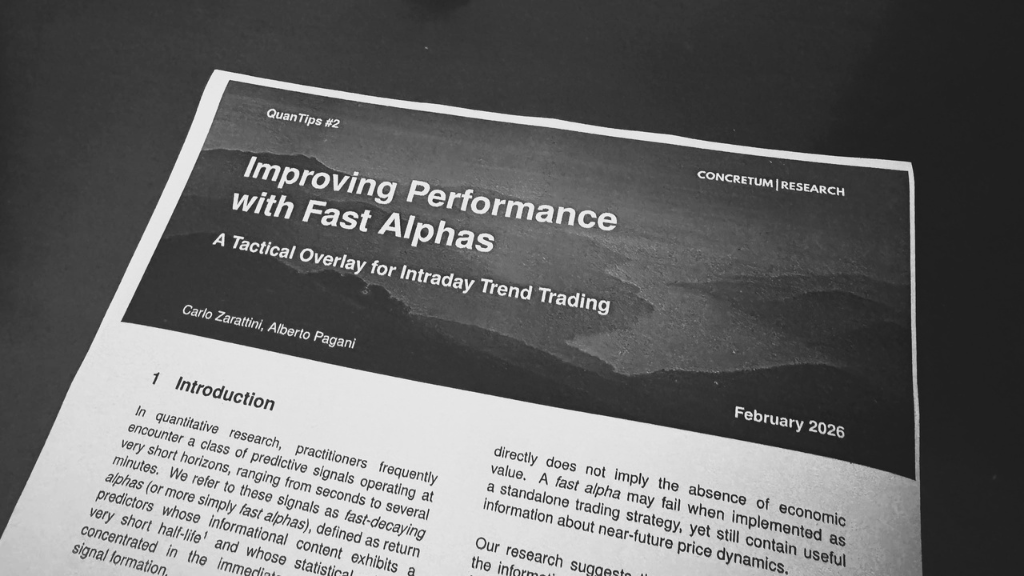
QuanTip: Improving Performance with Fast Alphas; A Tactical Overlay for Intraday Trend Trading
This research note argues that fast predictive signals which fail after transaction costs may still possess
economic value when used as informational alpha rather than traded directly. Using 5-minute intraday SPY
data from 2007 to 2026, a short-horizon mean-reversion signal is shown to be unprofitable on a standalone
basis but improves the net performance of an intraday trend-following strategy when applied as a tactical
execution overlay, increasing net-of-fee CAGR and Sharpe ratio.
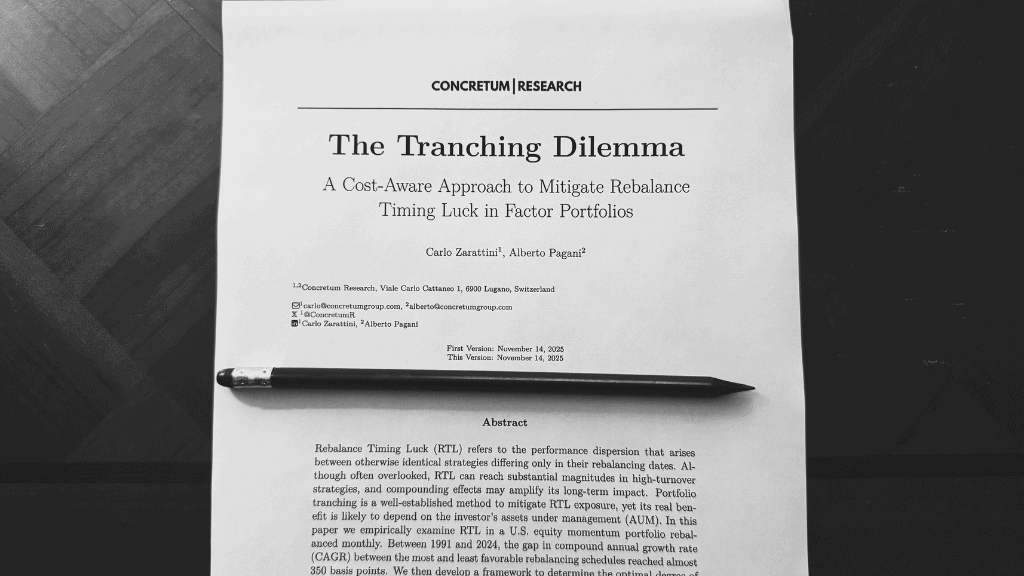
The Tranching Dilemma. A Cost-Aware Approach to Mitigate Rebalance Timing Luck in Factor Portfolios
Rebalance Timing Luck (RTL) describes the performance differences that occur when identical investment strategies rebalance on different dates. Although often ignored, RTL can become significant—especially in high-turnover portfolios—where compounding magnifies long-term effects. Using a U.S. equity momentum strategy from 1991–2024, the difference between the best and worst rebalancing schedules reached nearly 350 basis points in annual returns. While portfolio tranching can reduce RTL, its net benefit depends on investor size: large and institutional investors may benefit, but for smaller investors, increased trading costs often outweigh the advantage. As a result, retail investors must generally accept RTL as an unavoidable part of rotation-based investing.

ChatGPT in Systematic Investing – Enhancing Risk-Adjusted Returns with LLMs
This paper investigates whether large language models (LLMs) can improve cross-sectional momentum strategies by extracting predictive signals from firm-specific news. We combine daily U.S. equity returns for S&P 500 constituents with high-frequency news data and use prompt-engineered queries to ChatGPT that inform the model when a stock is about to enter a momentum portfolio. The LLM evaluates whether recent news supports a continuation of past returns, producing scores that condition both stock selection and portfolio weights. An LLM-enhanced momentum strategy outperforms a standard longonly momentum benchmark, delivering higher Sharpe and Sortino ratios both in-sample and in a truly out-of-sample period after the model’s pre-training cutoff. These gains are robust to transaction costs, prompt design, and portfolio constraints, and are strongest for concentrated, high-conviction portfolios. The results suggest that LLMs can serve as effective real-time interpreters of financial news, adding incremental value to established factor-based investment strategies.
The Volatility Edge: A Dual Approach For VIX ETNs Trading
This paper shows how individual investors can profit from the volatility risk premium using VIX-linked ETNs. A dynamic strategy tested from 2008–2025 yields strong returns with low equity correlation. With proper tools, volatility trading is now accessible—but must be approached cautiously.

Catching Crypto Trends; A Tactical Approach for Bitcoin and Altcoins
This study adapts trend-following strategies—rooted in traditional finance—to cryptocurrencies, using Donchian channel ensembles and volatility-based sizing. Applied to a rotational portfolio of top coins, the strategy delivers strong risk-adjusted returns, outperforming Bitcoin with notable alpha. It also addresses transaction costs and explores integration with traditional asset strategies, offering practical on- and off-chain implementation paths.
Does Trend-Following Still Work on Stocks?
This study revisits Wilcox and Crittenden’s 2005 work on trend following in stocks, analyzing 66,000+ trades from 1950–2024. Results confirm that less than 7% of trades drive profitability, with strong out-of-sample performance (2005–2024). A backtested portfolio shows high gross returns but faces turnover challenges. A Turnover Control algorithm mitigates costs, making the strategy viable across portfolio sizes after fees.

The Power Of Price Action Reading
This study evaluates the effectiveness of technical analysis in trading, particularly in how it enhances the performance of a simple automatic trading strategy. We simulate a trading environment where a skilled technical trader guides the strategy to focus on stocks with promising charts, especially those with significant overnight gaps. The trader also micromanages open positions by analyzing daily and intraday price actions. The findings indicate that skilled discretionary technical trading can significantly improve trading outcomes, providing empirical support for combining systematic and discretionary approaches in financial markets.

A Century of Profitable Industry Trends
This study examines the profitability of a long-only trend-following portfolio across 48 industry sectors from 1926 to 2024. The analysis demonstrates the model’s effectiveness through its 18.5% average annual return, significantly outperforming the US equity market’s 9.7% return. The Timing Industry strategy not only offers higher returns but also reduced volatility and drawdowns, achieving a Sharpe Ratio of 1.46. We also analyze the performance using 31 sector ETFs over the past 20 years, confirming the strategy’s robustness and profitability even after accounting for trading costs.

Beat the Market: An Effective Intraday Momentum Strategy for S&P500 ETF (SPY)
This paper investigates a simple yet effective intraday momentum strategy for SPY, a highly liquid ETF tracking the S&P500. Unlike typical studies that limit trading to the last 30 minutes, our model initiates trades based on intraday demand/supply imbalances. Using techniques from active day traders and dynamic trailing stops, the strategy achieved a 1,985% total return (net of costs), 19.6% annualized return, and a 1.33 Sharpe Ratio from 2007 to early 2024. We analyze its performance across market volatility regimes, day-of-the-week effects, and compare it to other technical patterns, considering the impact of commissions and slippage.

A Profitable Day Trading Strategy For The U.S. Equity Market
This paper examines the effectiveness of the 5-minute Opening Range Breakout (ORB) strategy for day trading U.S. stocks, focusing on its performance from 2016 to 2023. It highlights the advantages of trading “Stocks in Play,” which are highly active due to significant news, demonstrating how they significantly outperform regular stocks. Our comprehensive analysis, the first of its kind, details the strategy’s returns across various time frames and provides specific data on the top and bottom 25 performers.