
How to use option-implied volatility to better calibrate intraday breakout bands and position sizing.
Over the past few years, we have published a series of research articles documenting the robustness of intraday trend-following models on SPY and other liquid equity index products.
The appeal of these strategies is not only their standalone return profile. In many cases, their real value comes from the fact that, by construction, they deliberately take orthogonal exposure from a passive long-only equity allocation. This can translate into a significant benefit in terms of correlation control and alpha generation.
Our public work on this topic started with Beat the Market: An Effective Intraday Momentum Strategy for S&P500 ETF (SPY), published in 2024, where we showed how intraday demand and supply imbalances can be transformed into a systematic trend-following framework.
Most of the models we have presented so far share a common design choice: they use recent realized volatility to define the intraday breakout levels and, in many cases, to size positions dynamically.
That choice is simple, transparent, and hard to dislike. But it is also backward-looking.
This naturally leads to a question we wanted to test more carefully:
Can implied volatility improve the precision with which we define breakout levels and size intraday trades?
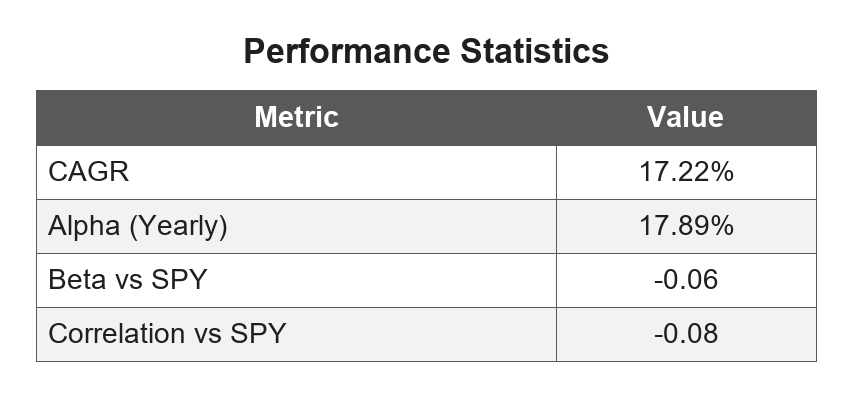
In this article, we introduce the full rules behindan effective intraday volatility breakout strategy on SPY that compounds at 17% per year (net of cost) over the backtest window, while showing an annualized alpha of ~18% and a beta of -0.06 versus SPY.
We then replace historical volatility with VIX readings when calibrating the bands and assess whether option-implied volatility can improve the effectiveness of the strategy. We will show that VIX data can be used more effectively when we avoid introducing unnecessary lag in the volatility input.
Moreover, we ask whether implied volatility can be used for another part of the model: position sizing.
Finally, we assess whether VIX information becomes more useful during macro-announcement days such as FOMC, CPI, ISM, Initial Jobless Claims, and Nonfarm Payrolls.
There are several useful lessons in this article. Enjoy your read.
Premium article
Read the full article
Buy this article on its own, or subscribe on Substack to read it together with all our premium research.
Questions about buying or your order? Email [email protected]